

A practical guide to accurate moisture and dry matter measurements
Measuring moisture content is essential in countless industries — from food and building materials to pharmaceuticals and chemicals. Accurately determining the moisture percentage helps to safeguard the quality, shelf life and processability of products. In this article you will read how to get the most out of your measurements with a moisture analyser.
How it works, choosing the temperature and switch-off criterion, and the comparison with the drying oven are covered in the knowledge base: how does a moisture analyser work.
Why moisture measurement matters
Moisture content is not just a number on a datasheet. Among other things, it determines:
-
The quality and consistency of products
-
The shelf life and microbiological stability
-
The processability during production
-
The price when buying and selling on a dry matter basis
It is therefore no surprise that moisture analysis plays a crucial role in the quality control of food, pharmaceutical powders, grains, building materials and plastics, among others.
What is a moisture analyser?
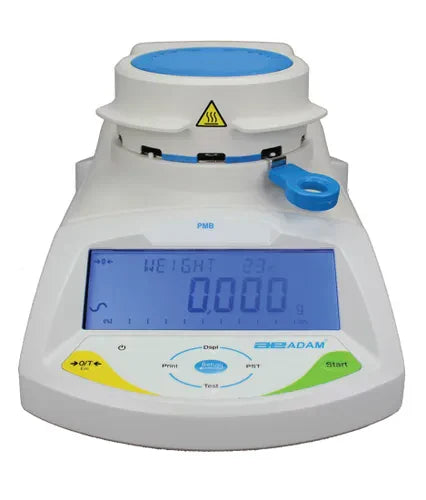
A moisture analyser – also called a dry matter balance – is a compact instrument that uses heat to remove the moisture from a sample. The instrument measures the weight before and after heating and uses this to calculate the moisture percentage or the dry matter content.
Most modern analysers use a halogen heating system that ensures fast and even drying.
Drying oven or analyser?
Although traditional drying ovens are still in use, the moisture analyser has clear advantages:
| Feature | Drying oven | Moisture analyser |
|---|---|---|
| Drying time | Long (often >1 hour) | Short (5–15 min) |
| Sample quantity | Large (5–10 grams) | Small (1–3 grams) |
| Heating method | From the outside in | Directly via halogen lamp |
| Ease of use | Requires a lot of manual work | Automatic, intuitive |
| Result | Manual calculation | Direct reading on the display |
For fast, day-to-day quality control, a moisture analyser is therefore often the better choice.
What should you look out for to get reliable measurements?
-
Homogeneous sample
Make sure the sample is representative. If necessary, grind the product finely to ensure even drying. -
Correct temperature setting
Not every product is the same. Temperatures that are too high can evaporate volatile substances other than water (such as alcohol or oil), which distorts the measurement. -
Calibration and maintenance
Regular calibration of both the balance and the temperature settings is crucial for accuracy. -
Stable working environment
Avoid draughts, vibrations and temperature fluctuations. Place the analyser on a vibration-free table in a room with a constant temperature.
Applications in practice
The moisture analyser is used in many sectors:
-
Food industry: measuring moisture in flour, coffee, meat, dairy products
-
Construction sector: analysis of sand, cement, wood fibres
-
Pharmaceuticals: testing active ingredients and excipients
-
Plastics production: checking the moisture in granulates before processing
In the production of bio-based building materials, for example, as at our customer Millvision, checking the moisture content is essential for the structural properties of the end product.
A smart choice for professionals
Anyone looking for a user-friendly and accurate moisture analyser often chooses a model with halogen heating, automatic end-point detection and programmable settings. A good example is the ADAM PMB Moisture Analyser, a compact and reliable solution that is popular with quality control professionals.
Conclusion: choose certainty in your measurements
A moisture analyser is a valuable instrument for anyone who wants fast and accurate insight into the moisture or dry matter content of products. By investing in a good instrument and paying attention to the right measuring conditions, you improve the quality and reliability of your production process.
🔍 Want to know more about moisture determination or need advice?
Contact the specialists at Weighing Experts with no obligation – we are happy to help you get started.