

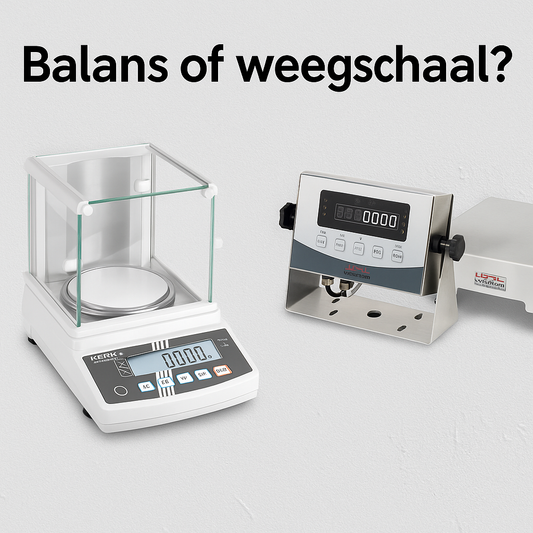
Balance or scale?
When weighing products, accuracy is crucial. But should you choose a balance or a scale? Although the terms are often used interchangeably, there are clear differences between the two instruments.
What is a balance?
A balance is designed for extremely precise measurements, often accurate to 0.001 gram. This makes balances ideal for applications such as laboratories, pharmaceuticals and quality control. Modern balances use advanced technology, such as load cells or electromagnetic force compensation. They measure mass rather than weight and are suitable for small quantities, where consistency and repeatability are important.
Typical features of a balance:
-
Accuracy to 0.001 gram
-
Measures mass (not force)
-
Perfect for micro-dosing and analysis
What is a scale?
A scale measures the weight of an object using a platform and a load cell. Scales are robust, fast and suitable for larger capacities – from kilograms to tonnes. They are widely used in production, logistics and trade. They usually display gross, tare and net weight, and are often suitable for 'Legal for Trade' applications.
Typical features of a scale:
-
Measures weight via force
-
Suitable for larger volumes
-
Quick and easy to use
-
Suitable for trade and industry
Balance vs. scale – the differences at a glance:
-
Accuracy: Balance – very high (milligrams); Scale – moderate (grams)
-
Capacity: Balance – low (up to 500 g); Scale – high (from kg to tonnes)
-
Application: Balance – laboratory; Scale – industry, logistics
-
Resolution: Balance – fine; Scale – coarse
Which should you choose?
Do you work with small quantities, such as substances or powders? Then a balance is the right choice. For heavier products or trade applications, a scale is more suitable.
Need help?
At Weighing Experts we are happy to help you choose the right measuring instrument for your situation.
Contact us via the contact form or call us on +31 345 785 553.